Ol Pejeta Conservancy

where rhino conservation writes its next chapter
Encounter East Africa’s largest black rhino sanctuary and stand face-to-face with the world’s last remaining northern white rhinos; this guide covers premier wildlife tracking, chimpanzee sanctuary visits, night game drives, and essential conservation access logistics.

360 km²

Conservancy area (140 sq mi)

2004

Conservancy status (chimpanzee sanctuary since 1993)

130+

Black rhinos — East Africa's largest sanctuary

Home to the last two northern white rhinos on Earth

Ol Pejeta Conservancy sits on the equator in Laikipia County, between the foothills of Mount Kenya and the Aberdares, roughly 3–4 hours’ drive north of Nairobi near the town of Nanyuki. Once a colonial-era cattle ranch, part of the land became Sweetwaters Game Reserve in 1988, then home to the Sweetwaters Chimpanzee Sanctuary in 1993 in partnership with the Jane Goodall Institute. In 2004, conservation partners secured the full property as a not-for-profit conservancy, reinvesting 100% of tourism income into wildlife protection and community development.

Ol Pejeta is genuinely singular: it’s the only place in East Africa where you can see the Big Five, both black and white rhino, and chimpanzees in one landscape. Its fenced Endangered Species Enclosure protects Najin and Fatu, the last two northern white rhinos left on the planet, while the wider conservancy holds East Africa’s largest and fastest-growing black rhino population — over 130 individuals under intensive, round-the-clock protection.

Ol Pejeta also pioneers a livestock-wildlife integration model, running thousands of cattle alongside its wildlife to fund conservation and support surrounding communities — a working example of conservation and commerce operating side by side, recognised on the IUCN Green List of Protected and Conserved Areas since 2014.

Ol Pejeta Conservancy

The best time for rhino & chimpanzee visits

Tap a season on the loop to see how conditions shift across the conservancy.

January – March

Dry, with blooming plains

A dry spell following the short rains leaves the plains in bloom, making for excellent photography alongside reliable game viewing.

Good to know: visits to the Endangered Species Enclosure (home to the last two northern white rhinos) and the Sweetwaters Chimpanzee Sanctuary are separate, bookable activities — not automatically included in a standard game drive.
Who you'll meet at Ol Pejeta

Ol Pejeta is unique in East Africa for combining the Big Five, both rhino species, and rescued chimpanzees in a single, privately managed conservation landscape.

Northern White Rhino

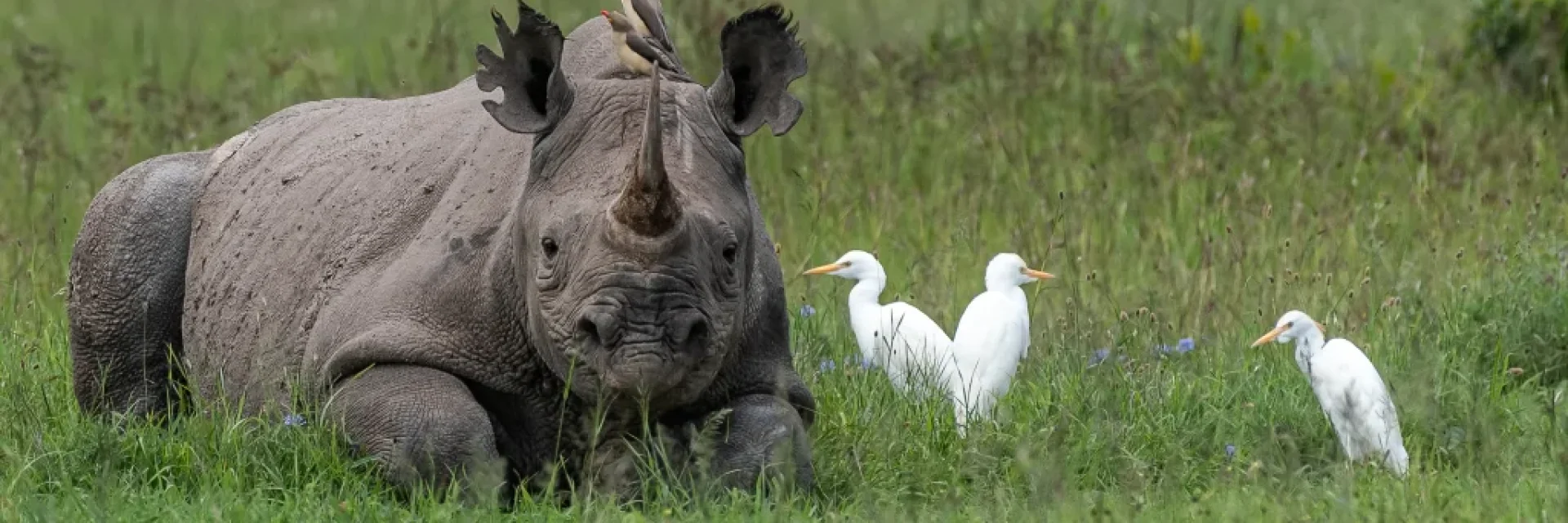
Black Rhino

Chimpanzee

Lion

African Wild Dog

Critically endangered
Northern White Rhino
Ceratotherium simum cottoni
Najin and Fatu, a mother-and-daughter pair, are the last two northern white rhinos on Earth, protected within a dedicated fenced enclosure and the focus of pioneering IVF research to save the subspecies.
Conservation icon
Black Rhino
Diceros bicornis
Over 130 individuals live here — East Africa’s largest black rhino sanctuary and the continent’s fastest-growing population.
Great ape
Chimpanzee
Pan troglodytes
The Sweetwaters Chimpanzee Sanctuary, run with the Jane Goodall Institute since 1993, is the only place in Kenya to see chimpanzees — all rescued from the illegal pet and entertainment trade.
Predator
Lion
Panthera leo
Resident prides are regularly tracked as part of Ol Pejeta’s predator monitoring programme, with lion-tracking activities available to visitors.
Predator
Leopard
Panthera pardus
Present across the conservancy’s woodland and rocky areas, though less commonly seen than the more visible predators.
Predator
Cheetah
Acinonyx jubatus
Hunts the open plains regularly, with Ol Pejeta’s low vehicle density making for exceptional cheetah photography.
Predator
African Wild Dog
Lycaon pictus
Packs have been naturally returning to Ol Pejeta in recent years and are closely monitored as part of the conservancy’s predator research.
Herbivore
African Bush Elephant
Loxodonta africana
Large herds move freely through the conservancy, directed along safe corridors by Ol Pejeta’s carefully designed perimeter fencing.
Dry-country specialist
Grevy's Zebra
Equus grevyi
An endangered breeding herd is closely managed and protected within the conservancy.
Dry-country specialist
Jackson's Hartebeest
Alcelaphus buselaphus jacksoni
A rare hybrid antelope reintroduced to Ol Pejeta to help maintain regional biodiversity.
Birdlife
300+ Bird Species
—
The conservancy’s mix of savanna, woodland, and riverine habitat supports a rich and varied birdlist.
Conservation model
Livestock-Wildlife Integration
—
Thousands of Boran cattle graze alongside wildlife under a carefully managed system — a working example of conservation and commercial ranching operating side by side.

Four faces of Ol Pejeta

The conservancy divides into distinct zones — pick a focus depending on what you want to see.
Ol Pejeta Conservancy
01

The Endangered Species Enclosure

A fenced, closely guarded sanctuary home to Najin and Fatu, the world's last two northern white rhinos, alongside Grevy's zebra and other threatened species.

BEST FOR: NORTHERN WHITE RHINO · CONSERVATION
02

Sweetwaters Chimpanzee Sanctuary

A riverine island enclosure along the Ewaso Nyiro River, home to rescued chimpanzees living in two large social groups.

BEST FOR: CHIMPANZEES · ONLY SITE IN KENYA
03

Open Plains & Woodland

The bulk of the conservancy, offering classic Big Five game drives, predator tracking, and low-density, intimate wildlife viewing.

BEST FOR: BIG FIVE · PREDATOR TRACKING
04

Community & Conservation Frontlines

Behind-the-scenes experiences — anti-poaching ranger activities, rhino tracking on foot, and Ol Pejeta's livestock-wildlife integration model in action.

BEST FOR: BEHIND-THE-SCENES ACCESS

When to visit

Ol Pejeta offers good wildlife viewing year-round, with the dry season providing the most reliable conditions for its full range of activities.
SeasonMonthsConditionsHighlights
Dry season / peak Jul - Oct Dry and reliable — the best conditions for the full range of activities. The most consistent game viewing of the year.
Dry, blooming plains Jan - Mar A dry spell following the short rains; wildflowers across the plains. Excellent photography conditions alongside good game viewing.
Short rains Nov - Dec Brief showers, plains greening up. Colourful migratory birds arrive; fewer visitors than peak season.
Long rains Apr - May Heaviest rainfall of the year; muddier tracks, but lush scenery. The quietest, most affordable time to visit.
Green-up Jun Rains easing, landscape at its lushest. Good transitional window ahead of the dry-season peak.

Getting there & getting around

By air

  • Ol Pejeta has its own airstrip for charter flights, roughly 45 minutes by air from Nairobi’s Wilson Airport.
  • A fast, comfortable option given the conservancy’s distance from Nairobi.

By road

  • Around 3–4 hours’ drive from Nairobi (roughly 200 km) via Nyeri and Nanyuki, on mostly tarmac road.
  • Often combined with Samburu, Lewa, or Mount Kenya on a wider northern Kenya itinerary.

Main entry gate

  • Main GatePrimary entrance, with conservancy maps available on arrival
  • Ol Pejeta AirstripCharter fly-in access point inside the conservancy

Inside the conservancy

  • Night game drives, guided walking safaris, and rhino or lion tracking are all available — unusual flexibility for a Kenyan reserve, though most carry separate activity fees.
  • Visits to the Endangered Species Enclosure and Sweetwaters Chimpanzee Sanctuary must be booked as specific activities, not assumed as part of a standard game drive.
  • Off-road driving is restricted to protect habitat; follow your guide’s lead.

Fees & rules, at a glance

Entry fees (non-resident foreign visitors)

  • Conservancy entry fees for adults have generally sat in the roughly US $110 per person, per 24 hours range in recent years, with children discounted.
  • Additional fees apply for vehicle entry and most specific activities — chimpanzee sanctuary visits, the endangered species enclosure, night drives, walking safaris, and similar experiences are priced separately.
  • Fees are reviewed periodically — always confirm current pricing directly with Ol Pejeta or your operator before budgeting a trip.
  • Most package safaris fold basic conservancy fees into the overall itinerary price, though special activities may cost extra.

Park etiquette & rules

  • Stay inside your vehicle at all times except during a booked walking safari or similar guided activity.
  • Keep a respectful distance from wildlife, particularly around the rhino enclosures.
  • Never feed or attempt to attract animals; keep noise to a minimum.
  • Ol Pejeta is a plastic-free conservancy — bring a reusable water bottle.

Where to stay

Accommodation ranges from tented camps to private cottages, most located inside the conservancy itself for early access to game drives and special activities.
sweet waters tented camp
Select
Sweetwaters Tented Camp
Sweetwaters Tented Camp (also referred to as Maisha Sweetwaters) sits within the conservancy near the chimpanzee sanctuary, offering comfortable, full-board tented accommodation with easy access to both rhino and chimpanzee experiences.

Before you go

A few practical notes to help you prepare for an Ol Pejeta safari, from what to pack to what to expect on the ground.
What to pack
  • Neutral-toned clothing for game drives and any walking safaris.
  • A wide-brimmed hat, sunglasses, and high-SPF sunscreen.
  • Binoculars — useful for both game drives and the chimpanzee sanctuary.
  • A reusable water bottle — Ol Pejeta operates as a plastic-free conservancy.
  • A light layer for cooler mornings and evenings at this moderate-altitude location.
Health & documents
  • A yellow fever vaccination certificate may be required depending on your travel history — check current Kenyan entry requirements before you fly.
  • Malaria risk is present in the region; consult a doctor about prophylaxis before departure.
  • A valid passport and Kenyan eTA/visa, arranged in advance according to current entry requirements.
  • Travel insurance that explicitly covers safari activities, including walking safaris, is recommended.
Money & connectivity
  • US dollars (cash, newer notes) and international cards are both commonly used for fees and lodges — confirm accepted methods with your operator ahead of time.
  • Mobile signal is generally reasonable across much of the conservancy.
  • Tipping guides and camp staff is customary; ask your operator for typical local guidance.
Getting the most from a visit
  • Book a visit to see Najin and Fatu, the last northern white rhinos on Earth — a genuinely once-in-a-generation wildlife encounter.
  • Add the Sweetwaters Chimpanzee Sanctuary to your itinerary — it’s the only place in Kenya to see chimpanzees.
  • Ask about rhino tracking on foot or a ranger-led experience for a deeper look at Ol Pejeta’s conservation work.
  • Plan for at least 2–3 nights to properly fit in the conservancy’s full range of activities without rushing.